

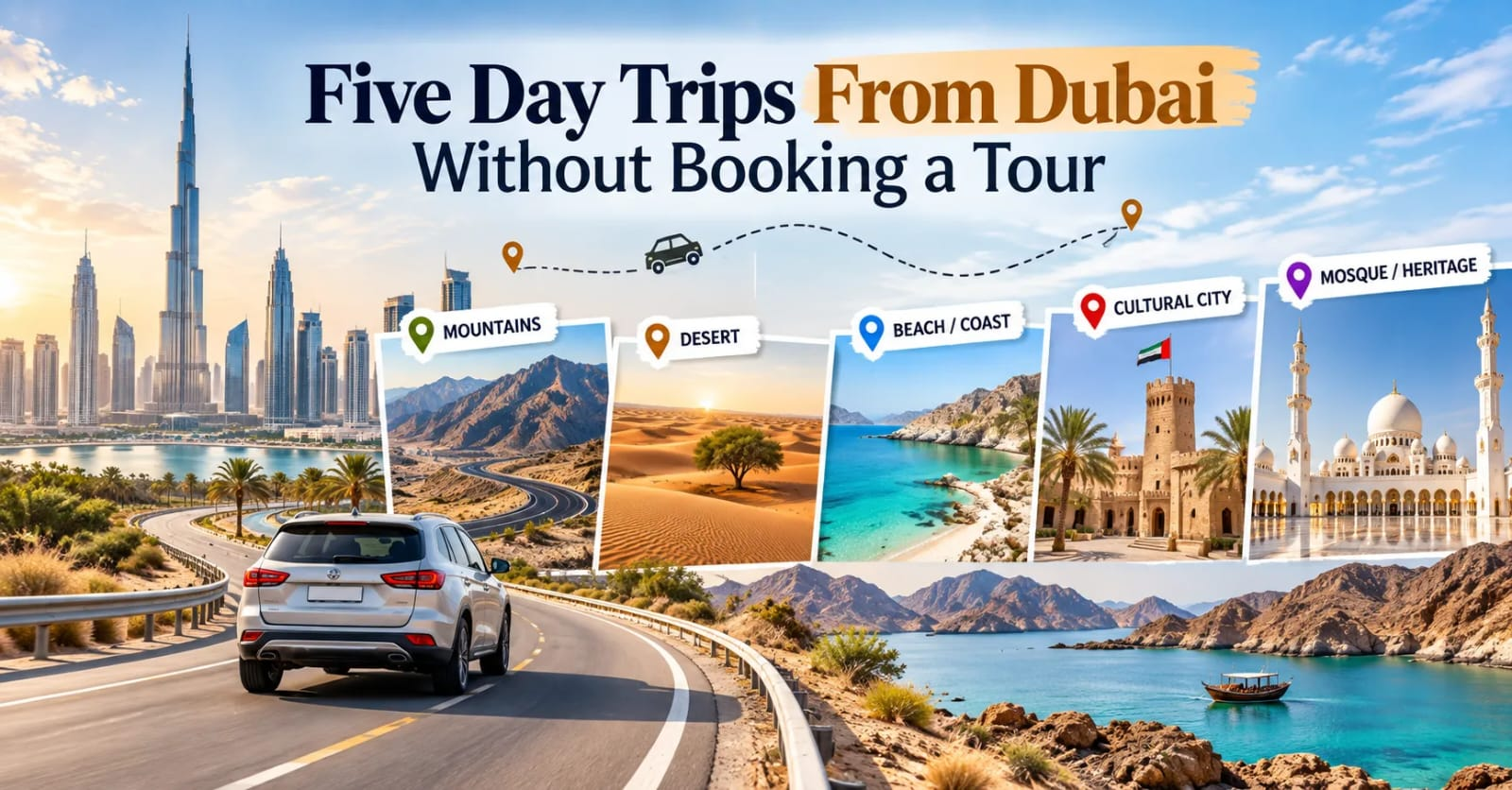
Dubai is closer to the rest of the country than most residents realise. A mountain wadi, a Gulf of Oman beach, a UNESCO oasis and two of the region’s best museums all sit within two and a half hours of the city, and every one of them can be reached on an ordinary weekend without a tour operator, a guide or, in most cases, a car. The five trips below are the ones worth doing first, with what each costs, how long it takes and which season suits it.
Two ways to get out of the city
The intercity buses are the cheap option and better than their reputation. They are air-conditioned coaches rather than city buses, they run to a timetable every day including public holidays, and they leave from a handful of stations, chiefly Union Square and Al Ghubaiba in the older districts, Ibn Battuta in the south and Etisalat in the north-east, all of which sit on the metro. Fares between emirates run from AED 10 to AED 35 one way. Dubai’s routes are paid for with a Nol card and take no cash, so load the card before you travel; Sharjah’s own buses take cash or a Sayer card, and Abu Dhabi’s take Hafilat.
Driving is faster and more flexible, particularly for the mountain destinations where the bus drops you in a town and the sights are spread out. It costs more than the fuel, though, and the extra costs are the ones visitors forget: Dubai’s toll gates on the way out of the city, and paid parking at the other end in emirates whose systems are nothing like Dubai’s. There is more on both below.
1. Fujairah and the east coast
The east coast is the trip that surprises people: two hours from Dubai, the landscape turns to the Hajar mountains and then drops onto the Gulf of Oman, with a proper coastline of dive sites and beaches. Al Bidyah Mosque, the oldest known mosque in the country, is a small mud-and-stone building with four pointed domes on a hillside north of Fujairah city. Fujairah Fort sits above the old village with the emirate’s museum beside it. Further north, Khorfakkan has the best public beach on the coast and a 3,600-seat amphitheatre built into the mountainside, and the waters off Al Aqah are where most of the country’s diving happens.
Getting there is one bus. The E700 bus between Dubai and Fujairah runs roughly every 45 to 60 minutes for AED 25 on a Nol card, takes about two to two and a half hours, and uses Etisalat Bus Station at the Dubai end, which keeps it clear of central Deira traffic. The first departure from Fujairah is around 6:30 AM and the last around 10:45 PM, so a day trip in either direction works comfortably. The route runs inland through Dhaid and Masafi, where the fruit and carpet market on the roadside is worth the five minutes it takes to walk through.
2. Hatta
Hatta is Dubai’s own mountain exclave, 130 kilometres east in the Hajar range and technically still the emirate. The dam and its turquoise reservoir are the postcard, and kayaks and pedalos are rented by the hour on the water. Hatta Heritage Village reconstructs a pre-oil mountain settlement around two original watchtowers, and the mountain-bike trail network above the town is the best in the country. It is a winter destination above all: the altitude makes it several degrees cooler than the coast, and the wadis are dry and walkable from October.
The RTA runs a bus service to Hatta from Dubai, the E16, though it is less frequent than the coastal routes and the departure point has changed over the years, so confirm the current timetable in the RTA’s S’hail app before committing to it. Most visitors drive, and the road through the Omani border area is now a straight run on the Dubai-Hatta highway with no crossing formalities.
3. Al Ain
The garden city is the only UNESCO World Heritage Site in the UAE, inscribed for its oases, tombs and the falaj channels that have irrigated them for three thousand years. Al Ain Oasis alone covers some 1,200 hectares of date palms with shaded walking paths and free entry. Jebel Hafeet, the mountain on the Omani border, has a road to the summit that is regularly called one of the best driving roads in the world, and the view at sunset justifies the cliche. Al Jahili Fort holds a permanent exhibition of Wilfred Thesiger’s Empty Quarter photographs.
The E201 connects Al Ghubaiba Bus Station in Bur Dubai with Al Ain Central Bus Station every 20 to 30 minutes for AED 25 on a Nol card, taking about an hour and three quarters. The oasis and the forts are walkable or a short taxi from the bus station; Jebel Hafeet is not, so that one needs a car or a taxi with a waiting arrangement.
4. Sharjah
Sharjah is twenty minutes away and consistently overlooked, which is strange given that it holds the best museum in the country. The Museum of Islamic Civilization occupies a restored souq building on the creek and its collection runs from astrolabes to a gold-thread kiswah panel from the Kaaba. The Heart of Sharjah restoration around Al Mureijah has turned merchant houses into galleries, Al Noor Island is a landscaped butterfly house and sculpture park in the middle of Khalid Lagoon, and Al Qasba is the family-evening end of things.
The E303 from Union Square and the E307 from Deira City Centre both run to central Sharjah every 15 to 20 minutes for AED 10, taking 45 minutes off-peak. Go on a weekend morning and come back before four; the evening traffic back into Dubai on Al Ittihad Road is the single worst commute in the country.
5. Abu Dhabi
The capital is a full day rather than an afternoon, and three sights carry it. Sheikh Zayed Grand Mosque is free to enter, open to non-Muslim visitors outside prayer times with modest dress required and abayas lent at the entrance. Louvre Abu Dhabi on Saadiyat Island arranges its collection chronologically across civilisations under Jean Nouvel’s perforated dome. Qasr Al Watan, the presidential palace, opened to visitors in 2019 and its library and Great Hall are the draw. The Corniche fills the evening.
The E100 from Al Ghubaiba and the E101 from Ibn Battuta run to Abu Dhabi Central Bus Station for AED 25 on a Nol card, every 15 to 20 minutes from before dawn, taking about two hours. From the bus station the sights need local buses on a Hafilat card or taxis, so budget for two or three short rides.
| Destination | Bus | Fare one way | Journey | Best for |
| Fujairah and the east coast | E700 from Etisalat Bus Station | AED 25 | 2 to 2.5 hours | Beaches, diving, Al Bidyah Mosque |
| Hatta | E16; confirm the timetable in S’hail | Check current fare | About 1.5 hours | Dam, kayaking, mountain biking |
| Al Ain | E201 from Al Ghubaiba | AED 25 | About 1 h 45 | Oasis, forts, Jebel Hafeet |
| Sharjah | E303 from Union or E307 from Deira City Centre | AED 10 | 45 to 90 min | Museums, Al Noor Island |
| Abu Dhabi | E100 from Al Ghubaiba or E101 from Ibn Battuta | AED 25 | About 2 hours | Grand Mosque, Louvre, Qasr Al Watan |
If you drive instead
A car makes the mountain trips considerably better and the Sharjah trip considerably worse. Two costs are worth knowing before you set off. The first is tolls: Dubai’s Salik gates sit on the main arteries out of the city, and since the 2026 change the charge varies by time of day rather than being flat. It is AED 6 at peak (roughly 6 AM to 10 AM and 4 PM to 8 PM, Monday to Saturday), AED 4 off-peak, and free between 1 AM and 6 AM every day, with adjusted windows during Ramadan. Crossing a gate with an empty tag can generate a violation rather than simply a deduction, so check your Salik balance and top it up the night before a long drive; an early start before six is also free, which is another argument for leaving at dawn in summer.
The second is parking. Each emirate runs its own system with its own zone numbers, SMS formats and free periods, and a Dubai parking app does not pay for a space in Sharjah or Ajman. Read the sign, note the zone code, and pay by the local method before you walk away.
Practical notes
- Season. October to April for everything on this list. Hatta and Al Ain are pleasant into May; the east coast beaches are humid but swimmable most of the year.
- Fridays. Prayer times close some attractions for an hour or two around midday and the Grand Mosque is closed to visitors on Friday mornings; check before building a Friday itinerary around one site.
- Carry the card, not the cash. Dubai’s intercity buses take Nol only. Load AED 60 or so before a day trip, which covers a return fare with margin.
- Timetables move. Intercity schedules change with the season and with Ramadan. Confirm departures in the S’hail app on the morning you travel.
None of these trips needs more than a day, a bus ticket and an early alarm, and between them they cover mountains, coast, oasis and two world-class museums. The tour operators charge several hundred dirhams for versions of the same itineraries with a guide attached. The buses run anyway.
Fares, timings and toll rates checked September 2026; confirm intercity departures in the RTA S’hail app before travelling.
