

Dubai has spent more than a decade building its reputation as a city that runs on technology. Government services moved online early, free zones attracted global tech firms, and national strategies put artificial intelligence at the centre of the UAE’s long term economic plans. Now that push is reaching everyday businesses, from a ten-person real estate brokerage in Business Bay to a logistics operator moving cargo through Jebel Ali.
For business owners, the shift is practical rather than futuristic. Customers expect replies within minutes, teams are stretched across time zones and languages, and competitors are already trimming costs with smarter workflows. This is why more leaders are looking for an AI automation company in Dubai that can turn scattered manual tasks into reliable, connected systems.
This article looks at why Dubai is such a strong environment forAI adoption, what these tools actually change inside a company, where results are showing up first, and how to start without wasting budget.
Why Dubai is a Natural Home for AI and Automation few conditions make Dubai different from many other business hubs.
Clear government direction. The UAE launched its National Strategy forArtificial Intelligence 2031, and Dubai has backed it with its own digital and AI initiatives across public services. When the public sector adopts these tools openly, private companies feel both the pressure and the confidence to follow.
A multilingual, international customer base. A single company in Dubai may serve clients in English, Arabic, Hindi, Urdu, Russian and more, often on the same day. Manual handling of that volume is slow and expensive. AI-based tools can read, sort and respond across languages far faster than a team working through an inbox.
Fast-moving competition. Sectors such as property, hospitality, retail, trade and finance are crowded. A business that responds to a lead in two minutes tends to win over one that responds in two hours.
Openness to new technology. Companies in the region are generally willing to test new tools, which shortens the gap between a promising idea and a working pilot.
What AI and Automation Actually Change Inside a Company
The terms “AI” and “automation” are often used as if they mean the same thing. They overlap, but they solve different problems.
Automation follows fixed rules. When a form is submitted, create a record, send a confirmation, notify the sales team and add a follow-up task. It is dependable and ideal for repeatable work.
AI handles tasks that need judgment or language understanding: reading a customer email, summarising a call, scoring a lead, or answering a question in natural language.
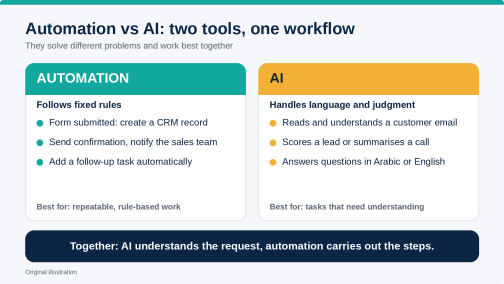
When the two are combined, companies usually see change in three areas.
1. Repetitive back-office work
Data entry, invoice processing, report preparation, appointment scheduling and document sorting are common starting points. These tasks eat hours every week, and errors creep in when people are tired or rushed. Automating them frees staff for work that needs real thinking.
2. Customer-facing communication
AI chat and messaging assistants can answer common questions around the clock, qualify enquiries and hand complicated cases to a human with the full conversation history attached. Since WhatsApp is a primary business channel in the UAE, many companies connect these assistants directly to it.
3. Decisions and forecasting
Predictive tools can flag which leads are most likely to convert, estimate demand, spot unusual transactions or highlight stock that is about to run short. The goal is not to replace managers but to give them better information sooner.
Where Dubai Businesses Are Seeing Results
While every company is different, a few sectors show clear and repeatable use cases.
Real estate: Automated lead capture from portals and ads, instant first replies, viewing scheduling, and follow-up sequences that keep prospects warm. Hospitality and tourism: Multilingual booking assistants, review analysis, dynamic pricing support and automated guest messaging before and after a stay. Logistics and trade: Shipment status updates, document checks, customs paperwork support and route or capacity planning.
Retail and e-commerce: Product recommendations, order tracking, returns handling and inventory alerts.
Financial and professional services: Client onboarding, document verification, compliance checks and report generation.
Healthcare and wellness: Appointment reminders, intake forms, patient FAQs and internal scheduling.
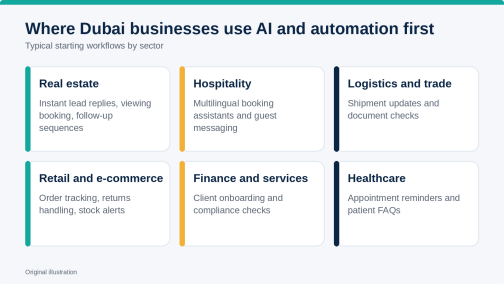
In almost all of these, the first wins come from a narrow, well-defined workflow rather than a company-wide overhaul.
From Chatbots to AI Agents
Early chatbots followed scripts and often frustrated customers. The newer generation of AI agents works differently. An agent can understand a request, look up information in your systems, take an action such as booking a slot or updating a CRM record, and then report back.
For example, a property enquiry that once needed three people could now be handled like this: the agent receives the message, checks available units, answers questions, books a viewing in an agent’s calendar and logs everything in the CRM. A human steps in only when the buyer is ready to negotiate.
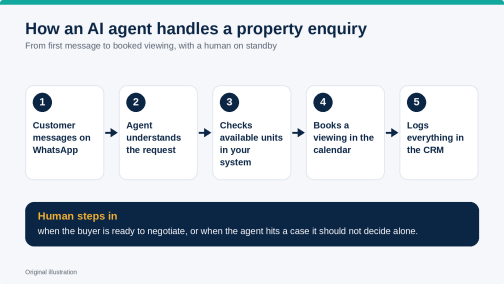
This is also why the choice of partner matters. An experienced ai automation agency does not just install a tool. It maps your process, connects the systems you already use, sets limits on what the agent may do, and builds in a clear path to a human when needed.
What to Look for in an AI Agency in Dubai
The market has grown quickly, and not every provider offers the same depth. When comparing an ai agency in Dubai, these questions help separate substance from sales talk.
1. Do they start with your process or with a product? Good partners ask how your team works today before recommending anything.
2. Can they show relevant examples? Look for work in your sector or with a similar problem, not just generic demos.
3. How do they handle integration? Tools that sit apart from your CRM, accounting software or messaging channels create more work, not less.
4. What is their approach to data and security? They should be able to explain where data is stored, who can access it and how it is protected.
5. Do they support Arabic and multilingual use? This is essential for many Dubai businesses.
6. What happens after launch? Monitoring, tuning and support often decide whether a project keeps delivering value.
If you want to see how a specialist team frames this kind of work, the AI automation agency in Dubai page from Stellen Infotech outlines the services and approach in more detail.
A Practical Roadmap for Getting Started
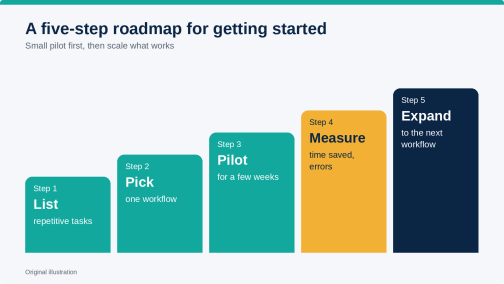
You do not need a large budget or a long timeline to begin. A sensible path looks like this.
Step 1: List your repetitive tasks. Ask each team where they lose time. Look for work that is frequent, rule-based and annoying.
Step 2: Pick one workflow. Choose a task with clear volume and a measurable result, such as lead response time or invoice processing time.
Step 3: Run a small pilot. Test with one team or one channel for a few weeks. Keep a human in the loop.
Step 4: Measure honestly. Compare time saved, error rates, response times and customer feedback against the old way of working.
Step 5: Expand carefully. Once the first workflow is stable, extend to the next one and connect them where it makes sense.
Common Mistakes to Avoid
Automating a broken process. If a workflow is confusing today, automation will only make it confusing faster. Fix the process first.
Trying to do everything at once. Large projects stall. Small ones ship.
Ignoring staff. People who understand the work should help design the solution. Explain what changes and what does not.
Skipping measurement. Without a baseline, you cannot tell whether the project worked.
Overlooking compliance. The UAE has a federal data protection law, and free zones such as DIFC and ADGM have their own regimes. Make sure any provider you choose understands the rules that apply to your business and your customers’ data.
The Road Ahead
AI and automation will not replace the human side of business in Dubai. Relationships, negotiation and trust still matter a great deal in this market. What changes is how much of the routine work sits between those moments. Companies that handle that routine work quickly and accurately gain time, consistency and room to grow.
For most businesses, the best next step is simple: pick one painful, repetitive process, find the right partner, and test it. The earlier you learn what works in your own operations, the better placed you will be as AI becomes a normal part of how Dubai does business.
Frequently Asked Questions
What does an automation company in Dubai do?
An automation company designs and builds systems that handle repetitive business tasks automatically. This can include lead management, customer messaging, invoicing, reporting, data syncing between software tools and workflow approvals. Many now also add AI features such as natural-language assistants and predictive analytics.
How is an AI agency different from a regular IT or software company?
A traditional IT company usually builds or maintains software and infrastructure. An AI agency focuses on applying machine learning, language models and automation to specific business problems, such as answering customer queries, qualifying leads or analysing documents. The two often work together, since AI tools need to connect to existing systems.
Is AI automation only for large companies in Dubai?
No. Small and mid-sized businesses often benefit quickly because a few automated workflows can save a lot of staff time. Starting with one process, such as lead follow-up or appointment booking, keeps costs and risks manageable.
Which business processes are best to automate first?
The best candidates are tasks that are frequent, rule-based and time-consuming: responding to new enquiries, scheduling, data entry, invoice handling, status updates and routine reporting. These offer clear results and low risk.
Can AI assistants work in both Arabic and English?
Yes. Modern language models can handle Arabic and English, and many other languages. Quality varies by tool and by use case, so it is worth testing with real customer messages, including dialect and mixed-language messages, before launch.
How long does it take to set up an AI automation project?
A focused pilot, such as a lead-response assistant or an automated reporting workflow, can often be running within a few weeks. Larger projects that involve several systems and teams take longer. Your provider should give a clear timeline after reviewing your process and tools.
Is my company data safe when using AI tools?
It can be, if the solution is set up properly. Ask where data is stored, who has access, whether it is used to train third-party models and how long it is kept. Choose a provider that can explain its security practices and that understands UAE data protection requirements.
How do I choose the right AI automation agency?
Look for a team that begins with your processes, shows relevant experience, integrates with your existing tools, supports multilingual needs and offers ongoing support after launch. Ask for a small pilot before committing to a larger project.