
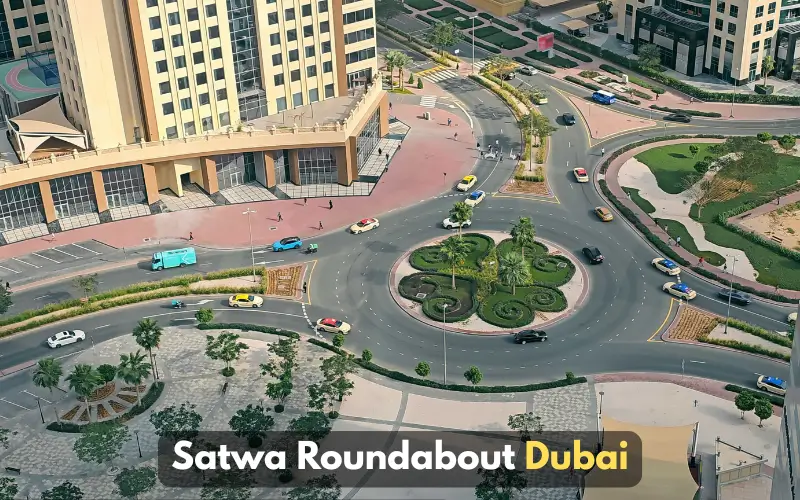
Satwa Roundabout is a huge, circular road junction in the Al Satwa region of Dubai. It’s one of the most active places in the neighborhood. 2nd of December Street and Al Satwa Road are the two main roads that come together here, and the smaller streets also link the roundabout from all sides.
Reasonably, in the middle of the roundabout is a small island. There is green grass, colorful flowers, and a pretty fountain on that island. It is all lit up at night, and it looks very beautiful. This intersection is where several thousand cars, buses, and other vehicles pass through every day.
Key Facts
- Location: Al Satwa, Dubai, United Arab Emirates
- Coordinates: 25.2191° N, 55.2726° E
- Main Roads: 2nd of December Street and Al Satwa Road
- Nearest Metro: World Trade Centre Station, about 2 km away
- Managed By: Dubai Roads and Transport Authority (RTA) and Dubai Police
- Special Feature: A green island in the center with a lit-up fountain
- Speed Limit: 40 km/h on all roads leading to the roundabout
- Open: 24 hours a day, 7 days a week
Where Is Satwa Roundabout?
The roundabout found in the western part of Dubai. It is approximately 3 kilometers from the city center. The famous Sheikh Zayed Road is a mere 2 to 3 km south. The streets near the roundabout are just made to function with bustling small shops, apartment blocks, and very busy people ,who get their day.
What Is Nearby?
The Iranian Hospital is situated to the west and is about 1.2 km away. The Satwa Grand Mosque is found at Al Satwa’s southwest corner. The Al Diyafa Shopping Centre is to the northeast. The Al Satwa Central Bus Station is located just a couple of blocks to the south.
The closest metro stations, the World Trade Centre Red Line station (around 2 km away) and Max Green Line station (1.5 km away), can be reached quickly by bus or taxi. Both stations are very convenient for passengers.
History
The existence of Satwa Roundabout dates back a long way to Dubai’s roads. In the sixties of the last century, Dubai started to build up the infrastructure of its first major road network. During this period, the first development plan of this city was made by a British planner, John Harris. Over the city, several roundabouts were constructed at significant road intersections. Satwa was one of them.
The vegetation on the middle island was initially just a simple patch of grass with a few small flowers. That was a general phenomenon in those times for roundabouts built in Dubai.
It was not until the eighties that a fountain was implemented in the center of the roundabout. This created an all-new majestic look to it. Thereafter, it became a much talked-about place among the people who resided in Satwa.
A Timeline of Important Events
1960s
The building of Satwa was overlaid, bearing the first street coordination pattern plan in Dubai.
1970s
A fountain and green plants were added to the central island, making it look much better.
1989
The Ravi Restaurant, a famous eating spot, started to operate next to the roundabout. It grew very fast and turned into one of the most popular restaurants in the area.
2008
The Umeirah Garden City project, a comprehensive regeneration effort, was announced. It was set up to replace old Satwa buildings with new high-rise buildings. Some of the old buildings were razed in the trial stage. Only the global financial crisis of 2008 prevented most of the work from continuing.
2023
RTA did the road repairs near the roundabout. Traffic was redirected through Kuwait Street for only 36 hours. Thereafter, everything went back to the normal flow of things again.
2025
In the Satwa region, the land was turned into a freehold area. This enabled people from other countries outside the UAE to buy and develop the land here. The technical report of the city states a few mid-rise buildings only, and the roundabout itself remains unchanged.
2026
During the holy month of Ramadan, Dubai Police selected the roundabout as a major location to carry out their road safety program. They also gave out free Iftar meals to people in the area.
What Does the Roundabout Look Like?
Satwa Roundabout is a traditional circular two-lane roundabout. Cars rotate in a clockwise manner around the roundabout, and there is only one road that is used for it. According to the estimate, the area of the island is 60-80 meters in width, and it is a little bit higher than the surrounding road.
The middle of the island is highly maintained. The perfectly cropped green lawn, flower beds, and an impressive fountain in the center are the main attractions of the place. The fountain has circular pools and water jets launch water into the air. During the night, the fountain lights are lit and make it majestic.
Each entrance into the roundabout is equipped with lampposts and signal signs, which are clear throughout. The roadsides of the roads and the roundabouts are dotted with palm trees. Among the buildings near, most are simple and low. Almost all shops occupy the blocks.
There is no pedestrian crossing on the roundabout itself. People have to use the platforms that are on the outer lanes of the flow of traffic to actually move around the roundabout. Consequently, this place is safer than other nearby clustered places.
How Does Traffic Work?
Satwa is one of the most crucial traffic areas in the middle of Dubai. Several big roads intersect at this traffic point.
2nd of December Street extends horizontally through the circle, connecting the Dubai Trade Centre and Sheikh Zayed Road in the east and Al Wasl Road and the Jumeirah area in the west.
Al Satwa Road from the north part of the City brings the local traffic into the Satwa neighborhood.
Under the modern road infrastructure in Dubai, the big roads like 2nd of December Street are interconnected with smaller roads. The south roads bring a lot of cars to the vicinity from other places in Dubai. The heaviest traffic happens in the morning and late afternoon.
Besides, the roads during the holy month of Ramadan get busy only five or ten minutes before the Iftar time starts, and then the traffic just eases down. In 2023, RTA did the road repair works, and the traffic was redirected through Kuwait Street for only 36 hours before everything went back to normal.
Public Transport Options
Satwa is a significant location for the RTA, as many buses pass through while some others stop at the nearby Satwa Bus Station.
- C1 and C26 buses, which are travelling to and from Dubai International Airport, are directly connected to the Satwa Bus Station for that reason.
- Route 55, which originates from Satwa, goes straight to International City.
- Route F11 and Route F12 run from Wasl Park to the Sheikh Zayed Road route.
Other bus routes, including X28, 88, 93, and 32C, are also within walking distance and easily reached by the citizens. Beyond that, it is very easy and very convenient to come and go by public transport.
What Makes Satwa Roundabout Special to the Community?
This is located in the heart of the vibrant and bustling neighborhood; regardless of being merely a bustling intersection, it has played a crucial role in defining and making the neighborhood “alive”.
Shopping and Tailoring
Satwa is a dream place for people who are into shopping for fabrics and sewing. The roads near the roundabout have a lot of shops that sell textiles. They include the sale of materials, saris, leather, and many other products.
The tailors are among these shops and can make clothes appropriately. Individuals from all over Dubai come to this shopping place. Gulf News describes Satwa as the one-stop shop not only for fabrics but also for tailor-made clothing.
Food and Restaurants
The area that surrounds the roundabout is very much associated with food. The most well-known spot is a Pakistani place owned by Ravi Restaurant, which has been established for many decades and has been such a favorite with the clients.
There are also many small coffee shops, sweet shops, and South Asian food nooks distributed all throughout. Whether workers or families, they all come to enjoy nice as well as affordable dishes here.
A Multicultural Neighborhood
Satwa is a haven for people from different countries. Many are OFWs or “Mini Manila” residents, giving the area its nickname. People from Pakistan and India as well as other South Asians, also reside here. The roundabout serves as the main center point for all the communities.
Gulf News, while explaining the vibrant and colorful life of Satwa, described it as “a hub of activity where people of all walks of life relate to each other like an Aladdin’s cave of endless bargains and discoveries”
Satwa Roundabout in Culture and Art
For those who have lived in Dubai for a long time, Satwa is more than just a traffic intersection. One can see the roundabout in old photos and articles about Dubai. Thus, it is more common for people as a familiar and beloved landmark.
Satwa Stories, a project from 2008 that included spoken words, started the narration of the story with the roundabout, the first thing one sees when one enters Satwa. This shows clearly how the roundabout is deeply interwoven with the identity and memory of the region.
Night photographs of the roundabout, the fountain, and the needed light lines are the ones that most lovers of photography prefer. Those photographs make volunteers, the people who show tourists around, and aspiring travel bloggers look at Satwa Roundabout every time a visitor asks them to.
Redevelopment Plans and Recent Changes
Plans for Satwa’s reorganization existed among the policies for a long time. In 2008, Meraas, a development company, introduced the massive project referred to as Jumeirah Garden City.
It covered a region of 9 square kilometers and had a plan to demolish the old buildings in Satwa, replacing them with skyscrapers. These should have started in the early stages of the project, but were actually demolished.
Then the global crisis in 2008 came up, and these all ceased. The roundabout remained untouched and continued to sit in the same exact location where it always was.
2025, the land in Satwa was freed. It let people from outside the UAE to buy and develop part of the land. Several mid-size skyscrapers are going to be built, though the roundabout will stay as it is.
In 2023, the RTA made some minor road repairs near the roundabout. During the repair, however, the traffic was redirected through Kuwait Street for 36 hours. This repair improved the situation, and the roads went back to their regular routes.
Who Manages Satwa Roundabout?
The responsibility for the roundabout at Satwa is shared among several government bodies.
The RTA- Roads and Transport Authority maintains and runs the road, the central island, the lights, and the traffic signs on it. The RTA also does all the major road work and traffic diversions.
The Green and Beautification Department of Dubai Municipality is the one that takes care of the plants, flowers, and the general appearance of the roundabout. The grass was then regularly cut, and flowers were planted every other season.
The Dubai Police Traffic Department is responsible for the implementation of rules and regulations, the control of accidents, and the regulation of traffic. They should also maintain the road signs. Thus, 40 km/h signs are located on the roads around the roundabout. There are also police officers and their mobile speed cameras patrolling the area.
Final Thoughts
Satwa Roundabout is a significant marker in Dubai, not merely a traffic spot. It was initially a part of Dubai’s road network in the 1960s but has become a daily place for thousands of people, which is far from its initial position.
Regardless of whether someone is visiting a tailor, eating at Ravi Restaurant, or catching a bus to another part of Dubai, Satwa always finds itself at the center of it all. It is one of the few remnants of Old Dubai that have withstood the test of time and still remains very stable in this perpetually changing city.
