
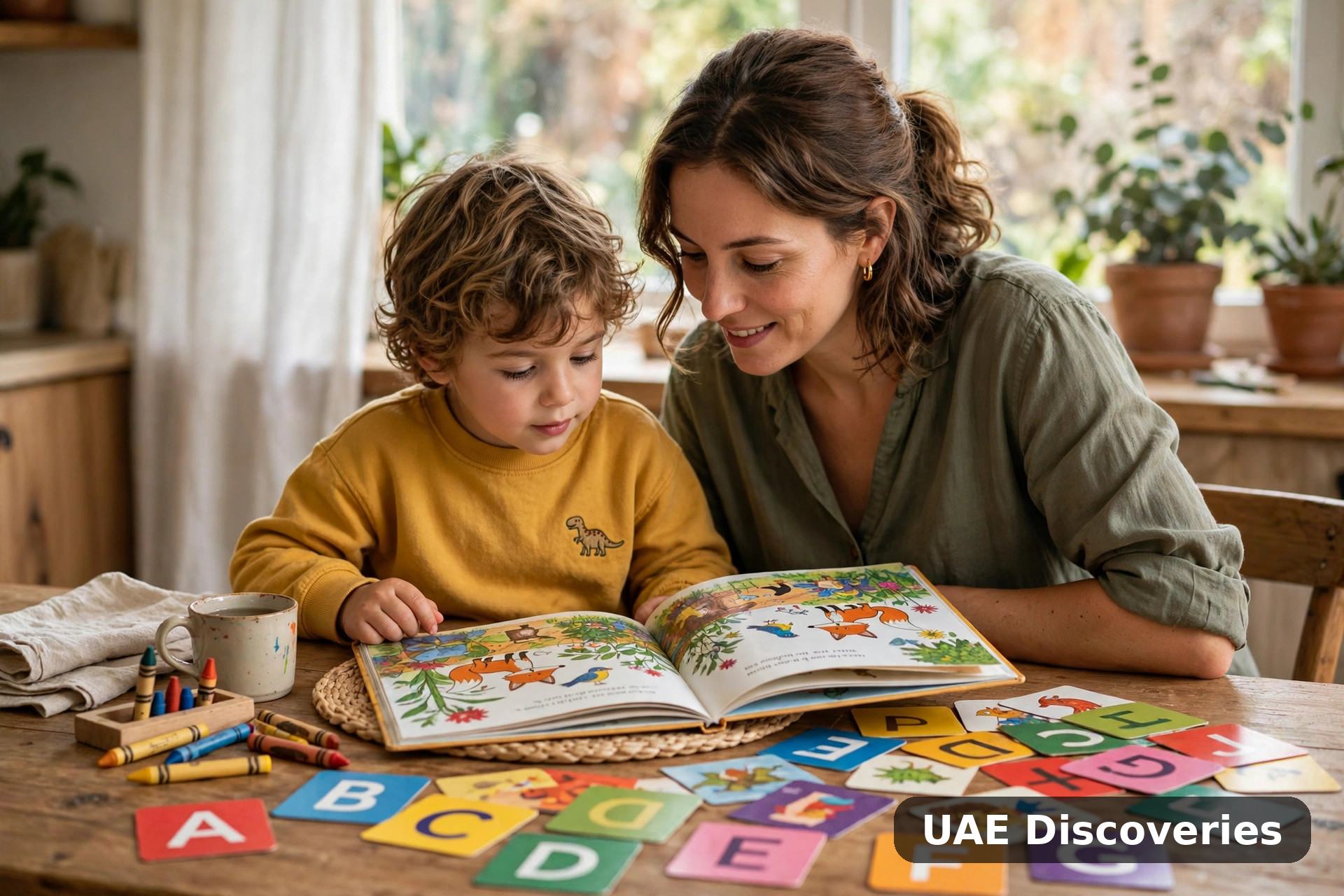
Learning to read starts with phonics, the method that teaches children how letters and groups of letters stand for the sounds of spoken English. Once that link clicks, printed words stop being puzzles.
Most schools in England teach reading this way from the first year, using a structured programme followed day by day. Parents who understand the basics can support the same steps at home.
This guide explains the key ideas in plain language: the sounds involved, the order they are taught, the skills of blending and segmenting, and the books children practise with.
What Phonics Is, in Plain Terms
Phonics teaches the relationship between sounds and spelling. A child who knows that the letter m says /m/ and the letter a says /a/ can start unlocking words instead of memorising them whole.
The approach replaces guessing with a strategy. Faced with an unfamiliar word, the child looks at the letters, says the sounds and blends them, which works on new words as reliably as practised ones.
Phonemes and Graphemes, the Two Key Words
A phoneme is the smallest unit of sound in a word. Spoken English uses 44 phonemes, from the /s/ in sun to the /ch/ in chip and the /igh/ in night.
A grapheme is the letter or letters that write a phoneme down. One letter may do the job, or two, three or even four, as the grapheme eigh shows in the word eight.
What “Systematic Synthetic” Actually Means
Systematic means the sounds are taught in a planned order, a few at a time, with nothing left to chance. Each new grapheme builds on the ones a child already knows.
Synthetic describes what children do with those sounds: they synthesise, or blend, them to read a word. Programmes such as the long-used Letters and Sounds framework follow exactly this pattern.
The reasoning behind the approach is set out in the official early reading guidance.
Blending, Reading the First Words
Blending is the skill that turns sounds into reading. The child says each sound in order, s-a-t, then pushes them together faster until the word sat appears.
Teachers practise blending aloud every day, first with spoken words and then with letters. Because the first taught sounds combine into many real words, children read genuine words within weeks.
Segmenting, the Spelling Side
Segmenting runs the same process backwards for spelling. To write pin, the child says the word slowly, hears p-i-n, and chooses a grapheme for each sound.
Reading and spelling therefore grow together rather than as separate subjects. A grapheme a child can segment for writing is also one they recognise instantly when reading.
The Order in Which Sounds Are Taught
Programmes begin with a small set of high-use letters, traditionally s, a, t, p, i and n. Those six alone can build words such as sat, pin, tap, pat and tip.
Digraphs follow, where two letters make one sound, as in sh, ch and ng. Later come alternative spellings for sounds already known, such as ai, ay and a-e for the same vowel sound.
Decodable Books That Match the Lessons
Practice books in a phonics programme are decodable, meaning they use only the graphemes a child has been taught so far. Every word on the page can be worked out with current knowledge.
That matching matters. A book filled with untaught patterns invites guessing from pictures, while a decodable book rewards the sounding-out strategy the lessons are building.
Parents can check what makes a book decodable with this guide to decodable reading books.
Tricky Words That Do Not Play by the Rules
Some very common words cannot be decoded with early phonics, because their spellings follow older patterns. Words such as the, said and was are taught as common exception words, often called tricky words.
Children learn to read these by sight while still sounding out the parts that do behave. Only a small set needs this treatment, and the decodable majority keeps growing around them.
Simple Ways to Support Phonics at Home
Short, regular practice beats occasional long sessions. Ten minutes of shared reading and sound games fits easily into a routine and keeps the school’s sequence moving forward.
- Ask your child to sound out one new word on each page before you read it together.
- Play spoken blending games on journeys: say s-u-n and let your child answer sun.
- Point out letters and digraphs on signs, packets and shop fronts during the day.
Above all, keep it playful and stop while it is still fun. Confidence grows fastest when practice feels like a game rather than a test.
More activity ideas are collected in these phonics games and activities for home.
Frequently Asked Questions
When do children usually start phonics?
Most children in England begin in the first school year, around age four or five, starting with listening games before letters. Programmes move at the class’s pace, with extra practice for anyone who needs it.
What is the Year 1 phonics screening check?
It is a short, one-to-one check in which children read 40 words aloud, half real and half made up. The made-up words show whether a child can decode using phonics alone.
Does phonics replace stories and reading for pleasure?
No. Phonics teaches the mechanics of reading words, while stories build vocabulary, knowledge and the desire to read. Children need both, and shared story time remains valuable long after decoding is secure.
Conclusion
Phonics gives early readers a dependable way into print: learn the sounds, blend them to read, segment them to spell, and practise with books that match. Supported steadily, the mechanics soon become invisible.