
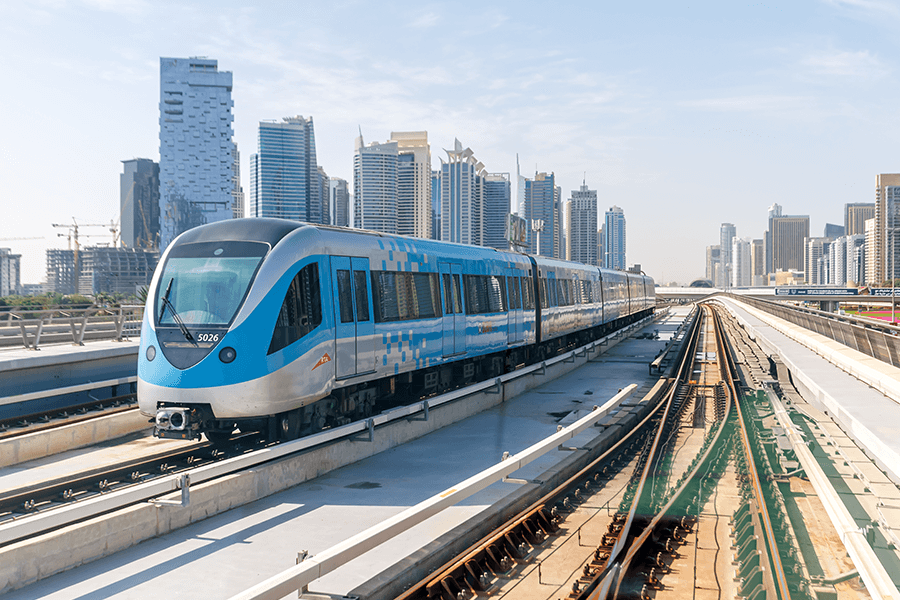
Dubai Metro Blue Line allows passengers to enjoy the benefits of fast, clean, and smart trains that have successfully altered the way they travel daily. We offer the spectators the urban road sector, new suburbs, the distance of 11,000 students, and the work centers of the labor market, in other words, in the outskirts of the city of Dubai, while the central 5.1 km of E-11 expressway 3 minutes.
Purpose and Benefits
The Dubai Metro Blue Line is the first of a very ambitious and far-reaching plan for the 2040 Urban Plan of Dubai. The basic purpose is a “20-minute city” where most needs get fulfilled within 20 minutes.
The line would act as a connector of the newly created nodes with the rest of the city by providing better transport facilities for people to reach homes, schools, and jobs in the areas that do not have the metro. International City, Dubai Silicon Oasis, Academic City, Ras Al Khor, and Festival City are the locations.
The line is expected to have 20% less traffic on the neighborhood roads. Residential property near the stations could rise in value by 25%. It is estimated that 56.5 billion AED will be the total money saved from time and fuel by the end of 2040. The project strives for the highest green standards (LEED Platinum).
Dubai Metro Blue Line Route and Stations
Y‑Shaped Alignment
Branch from Creek (Al Jaddaf) on the Green Line: This specific branch of the Dubai Metro Blue Line will go past Dubai Festival City, Dubai Creek Harbour (Emaar Properties station), Ras Al Khor, International City, Dubai Silicon Oasis, and stop at Dubai Academic City. Its length is approximately 21 kilometers and it passes through as many as 10 stations.
Branch from Centrepoint (Al Rashidiya) on the Red Line: The route goes through Mirdif, Al Warqa, and intersects International City 1 on the other branch. It is about 9 kilometers long with 4 stations along the line.
Main Interchanges
- Creek (Al Jaddaf) with the Green Line.
- Centrepoint (Al Rashidiya) is on the Red Line.
International City 1 is an underground Y‑junction where the two Blue branches meet.
Special Landmark Station
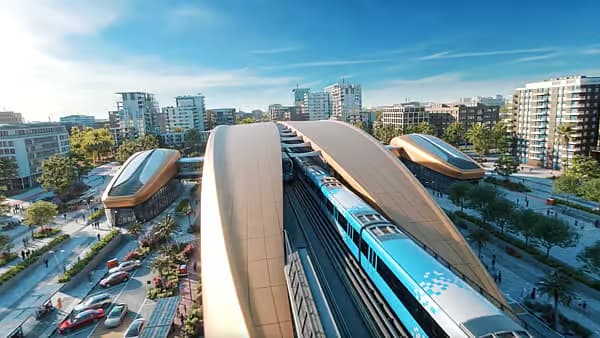
The Dubai Creek Harbour (Emaar Properties) station will be a superiorly tall landmark. The height is about 74 meters. It is one of the tallest stations of public transportation systems all over the world. It is a multifunctional station that will feature a very large crowd and offer its patrons modern services.
Construction Timeline and Status
- November 2023: The routes were approved.
- December 2024: The main construction contract is granted to a worldwide team led by MAPA–Limak–CRRC. The project manager is Parsons.
- June 2025: The ground was broken, and construction on the foundation works started.
- May 3, 2026: Tunneling run for the 15.5-kilometer underground section.
- Mid-2026: 20% of the work is done. The end of 2026 target is 30% completion.
- September 9, 2029: This is the official inauguration day.
Work is ongoing in various locations. A large number of deep foundations have already been built. A Metro bridge over Dubai Creek that is 1.3 kilometers in length is presently under construction.
The use of on-site concrete plants and precasting yards has enabled work to go on more rapidly. Right now, the project adheres to the set schedule.
Technical Specifications
Track and Power
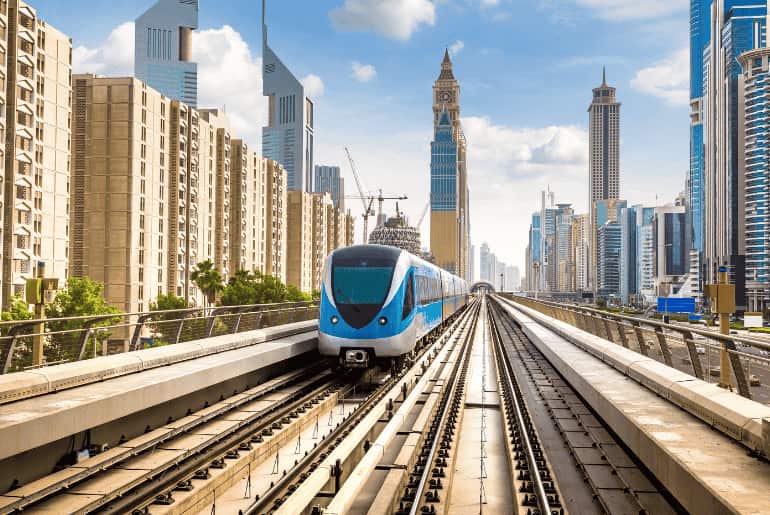
- Two tracks of standard gauge of 1,435 mm.
- Ballastless Concrete tracks are used for a smoother and quieter ride.
- 750 V DC third rail, same as Dubai Metro lines 1 and 2.
CBTC signaling for safe, frequent, driverless service and about 2-minute headways at peak.
Trains
- 28 brand-new automated/autonomous trainsets that have been built by CRRC Sifang.
- The top capacity of a train car is loaded to a maximum of about 46,000 passengers per hour per train at peak times.
The trains are sleek and lightweight, and you can board them with ease thanks to their wide doors
Stations and Design
Dubai Metro Blue Line will consist of a total of 14 stations, with 9 of them elevated and 5 underground.
- Platform screen doors will be installed at all the stations to improve passenger safety and realize the advantages of climate control.
- The stations will be air-conditioned, have a lift, ramp ways, and tactile paving, besides which clear signs will be put up. The International City 1 is essentially a huge underground track junction (approximately 44,000 m²).
Dubai Creek Harbor (Emaar) will be about 11,000 m² and get 85,000 real capacity.
Depot
A new depot in Al Ruwayyah 3 (to the east of Academic City) is intended to be used to store, clean, and repair the trains. The depot’s function is to secure trains, maintain their cleanliness, and keep them on time.
Operations and Ridership
The schedule of services will not change. Train movement is from the crack of dawn until 12 o’clock in the night on weekdays and until 2 am at weekends.
Fare payments will be conducted with Nol cards. It is planned to impose a special Dubai Metro Blue Line fare. All the stations are in the existing fare zones.
They want to operate a train service that spreads the trains to the point that they come approximately every 2 minutes during the peak hours. By 2030, it is expected that 200,000 riders per day will be on the line.
The number of riders will increase to 320,000 by the year 2040. The feeder services will be extended and adjusted to the bus routes to connect to new stations.
Connectivity and Airport Link
- Interchange with the Green Line at Creek (Al Jaddaf).
- Interchange with the Red Line at Centrepoint (Al Rashidiya).
- Transfer between Dubai Metro Blue Line branches at International City 1 (Y‑junction).
Around 20 minutes to Terminal 3 when making a change at Centrepoint to the Red Line. Further information is anticipated and will be updated a few months before the time of opening.
Experiences from full Nol card integration across metro, trams, and buses have shown that they have been the driver of higher productivity, savings, and efficiency.
Economic, Social, and Environmental Impacts
Economic: The lower rate in traffic and a decrease in fuel use are expected to save people money. Cumulative benefits may be as high as AED 56.5 billion by 2040. Properties near the stations could rise by 25%.
Some of the residential areas that the metro line is adjacent to include Academic City, Tech jobs in Silicon Oasis, Shopping centers in the Festival City, as well as International City and Mirdif. The line will serve close to one million people by 2040. 20-minute travels will be much more frequent.
Environmental: Electric trains help to reduce the number of cars used for commuting. This, in turn, effectively lowers carbon emissions and thus improves air quality. The project has set the highest green standards (LEED Platinum).
Accessibility and Passenger Amenities
Full step-free access: Elevators, ramps, and wide paths for wheelchairs and strollers.
- Use a tactile path and clear voice announcements to enhance the experiences of low vision users.
- Real-time screens will update you on train arrival times and any service changes.
- Each station will have air-conditioned spaces, bright lighting, seating arrangements, toilets, and smaller shops.
Bus stops get included along with integrated transportation, allowing for smooth transfers.
Safety and Security
High-tech driverless trains are used along with an automatic speed, and distance control system to ensure maximum safety.
- Platform screen doors will prevent any accidents as they stop a fall from the platform.
- The tunnel walls are equipped with fire detection and suppression systems.
- Closed-circuit television cameras and patrols watch carefully over the stations and trains.
- Ease of the emergency exits and the safety of plans for evacuation are clear.
There have been no reports of serious construction accidents through the end of 2025, which means that safety measures have been very effective.
Project Cost and Funding
- The project will cost about AED 20.5 billion, with USD 5.6 billion.
- This aspect is funded by the Dubai Roads and Transport Authority (RTA), along with the private partners.
- The MAPA–Limak–CRRC team was taking responsibility for the bridges and the stations, while Parsons was the project manager.
- No special tolls are programmed. Fares are bought with the help of the Nol cards, which are used on all other metro lines.
Controversies, Delays, and Legal Issues
As of mid‑2026, no significant public disputes or legal cases have been encountered. Bids were scrutinized and then awarded at the end of 2024. The first (before 2008) aircraft‑airport category was eliminated and replaced with a new plan that covered the new growth areas. The deadline for the project is still September 2029.
As things stand for now, the only expansion, as proposed for the 30 km Y‑shaped Line, is to add space for two additional stations. However, the list and locations are not given yet. The team is working to finish the Dubai Metro Blue Line on schedule. Other line extensions (such as the Gold Line) may be put off until each one is a standalone project.
Conclusion
The Dubai Metro Blue Line plans to connect the fastest developing parts of the city with a transport system based on fast, low-carbon, and safe rail service. The stations will be easy to use and accessible from the buses. The trains will run without any human operators and be close together, allowing for the best use of the road space and, consequently, fewer traffic jams.
The project is in harmony with the “20-minute city” goal, which means less traffic and cleaner air. The building of the line is going very well and thus is expected to be opened on the 9th of September, 2029.
